
Carmen Yuen | Lessons Learnt as an Early Stage Investor
:format(webp)/f/174198/1200x630/4321003823/carmen-lessons-learnt-as-an-early-stage-investor.jpg)
As we enter the final month of December 2022, it's timely to revisit the key events that have happened this year. One of which is that Vertex Ventures Southeast Asia & India embarked on raising our fifth fund. It is indeed a difficult year to raise funds given the nervous market outlook, how the public market has fared (or not faired) and the ever-increasing interest rates – which have yet to taper as I am writing this piece.
Southeast Asia is a nascent market for venture capital so we are grateful to have the privilege of having successfully raised several funds over the past decades. During our sharing with potential investors, we were often asked what key lessons we have learnt given Vertex Ventures has been in the venture capital business for more than 30 years. There are indeed many, and the following are some key observations.
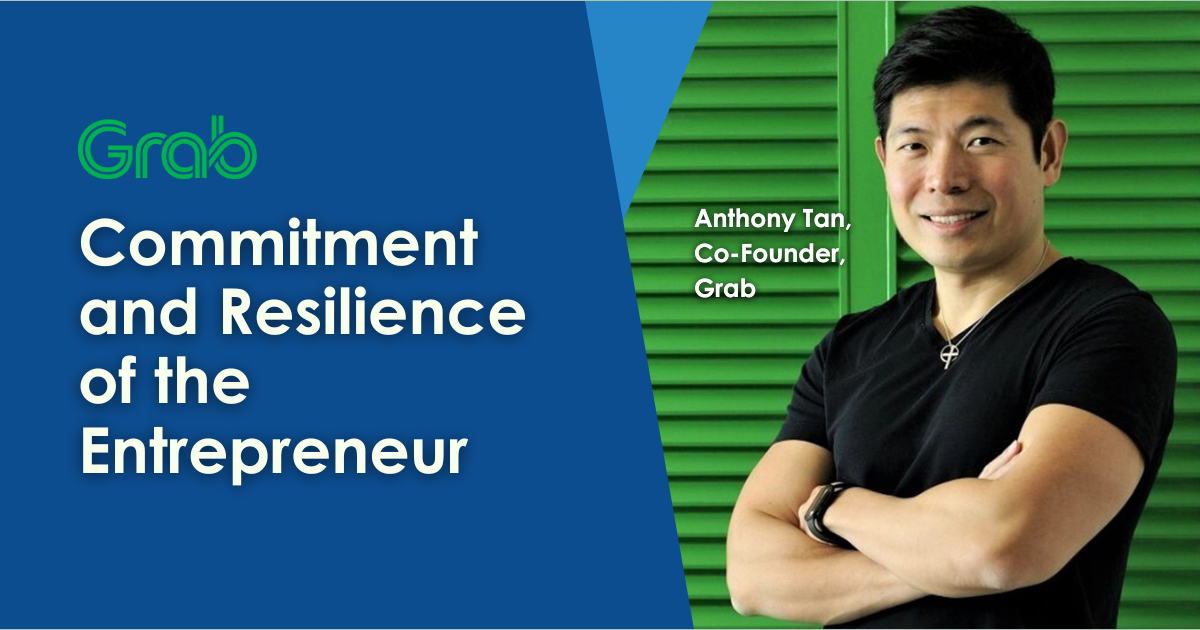
Commitment and Resilience of the Entrepreneur are hallmarks of success
We have had the privilege of being the first institutional investor in Anthony Tan and Grab. Anthony and his leadership team are notably ambitious and driven. When he pitched to Vertex, he had spotted a trend that was taking shape in North America and China – ride hailing. Seizing the opportunity, he launched a similar ride-hailing business in Southeast Asia – that’s how Grab got started in Kuala Lumpur. After Vertex invested in Grab, they moved the Headquarters to Singapore.
As a leader, Anthony walked the talk – despite his impossibly busy schedule, he was committed to working the grassroots including being a Grab driver, so as to have firsthand knowledge, insights and experience of the challenges of being a Grab driver. At the same time, being a user of his own app, he could appreciate the areas that needed improvement as far as the Driver App was concerned.
Anthony was also responsible to his investors. While some celebrated raising funds by throwing a big party, Anthony knew he had to be responsible for the funds entrusted to him. I was pleasantly surprised and heartened that he continued to travel on budget airlines to “stretch the dollar”. Personally, I had seen him in our office with a travel pillow in his backpack to support his back on the plane rides.
Anthony also knew when to empower his next level of leaders and he was deliberate in forming a close cadence with his trusted lieutenants so they could scale across the markets. Many of these leaders have gone on to be part of other excellent companies. Of course, since then, enough has been written about Anthony.
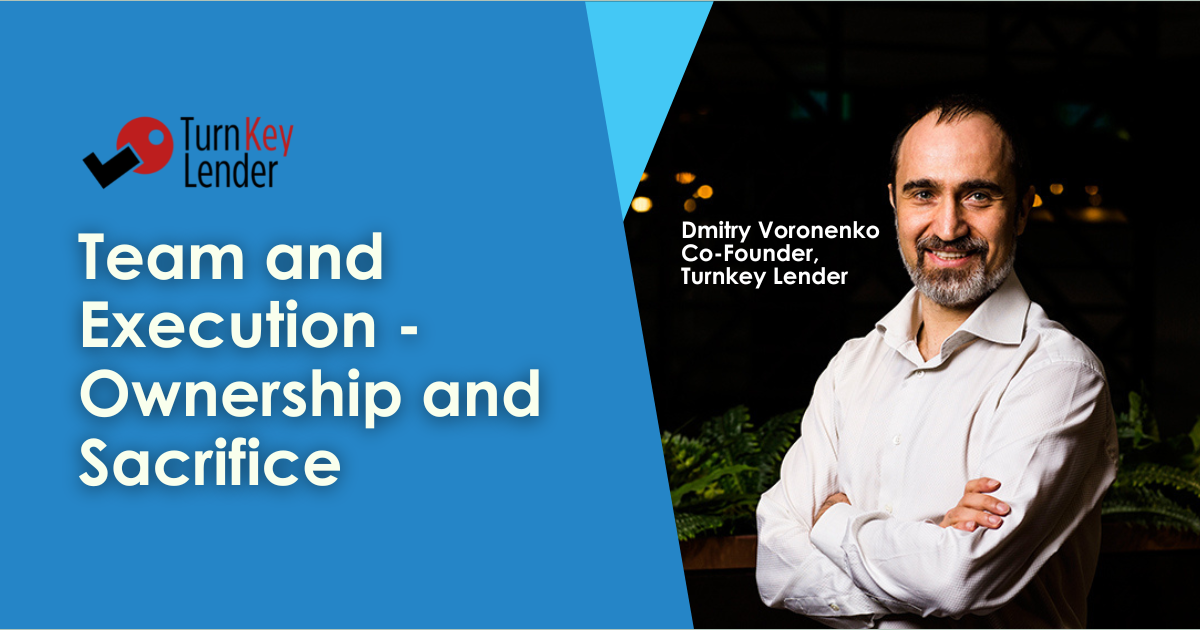
Team and Execution – Ownership and Sacrifice is essential
Dmitry and his core team at Turnkey Lender*, a global AI-powered lending automation platform, have developed a strong bond over the years and I see that this has been instrumental to their continual success. I recalled, during the period when the company was running low on cash, his management team had stepped forward to hold back their salaries (as did both founders - Dmitry and Elena) to ensure the other / younger teammates received salaries. This lasted not just for a month, but for several months when the fund raising process was delayed.
Turnkey’s core team is extremely talented and many had job offers from other tech companies, yet they did not throw in the towel and move on to the next better paying jobs. This demonstrates their firm commitment to the company, through the thick and thin.
I observed that while Dmitry was focused on fundraising, the team continued to focus on delivering on projects, working on next versions (including micro services) and garnering sales. Several even had to double hat and work way longer hours to ensure they met the delivery schedules.
The quality of their projects caught the eye of a number of solutions-providers, who eventually ended up working closely with the team as their channel partners. This strengthens the company’s go-to-market strategy. Such dedication and commitment by the core team was not earned overnight, but was developed over a period of more than 10 years and across at least two startups. This, to me, speaks of how the core team respects and trusts Dmitry as their leader!
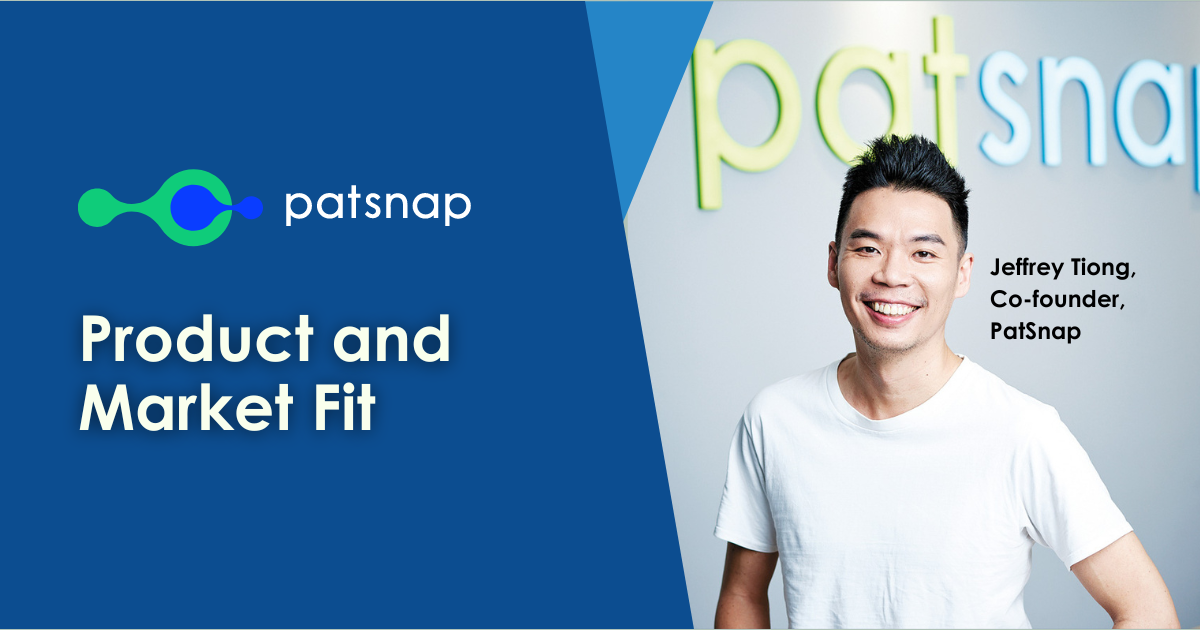
Getting to Product and Market Fit
Since the beginning, Jeffrey was determined that he did not want his company to be a “one-trick pony”. He started Patsnap* with the aim of providing Patent Engineers and Research Engineers with a platform to seek out ‘Freedom to Operate’ spaces. With the vision to see Patsnap eventually become the Marketplace for Innovation, Jeffrey had taken steps to regularly hear from the innovation community of what they are desirous of having.
Through much interaction with the community and multiple partnerships with different information providers, Patsnap is now availing its platform to more than 10,000 enterprises, spanning from the engineering sphere to life science and chemicals verticals; and tailoring to the varied needs for the Chinese, US and European markets.
With the vision in mind, he was also able to inspire his product managers, sales and business development teams across the markets to listen and obtain feedback from their customers. Throughout the COVID pandemic, Jeffrey held weekly calls with teams across the three time zones (US, Europe, SEAsia) to enable the teams to appreciate the problem statements and propositions that had worked elsewhere. These cross-geography learnings not only enabled Patsnap to adapt their products to fit different markets, it also enabled better team work across offices.
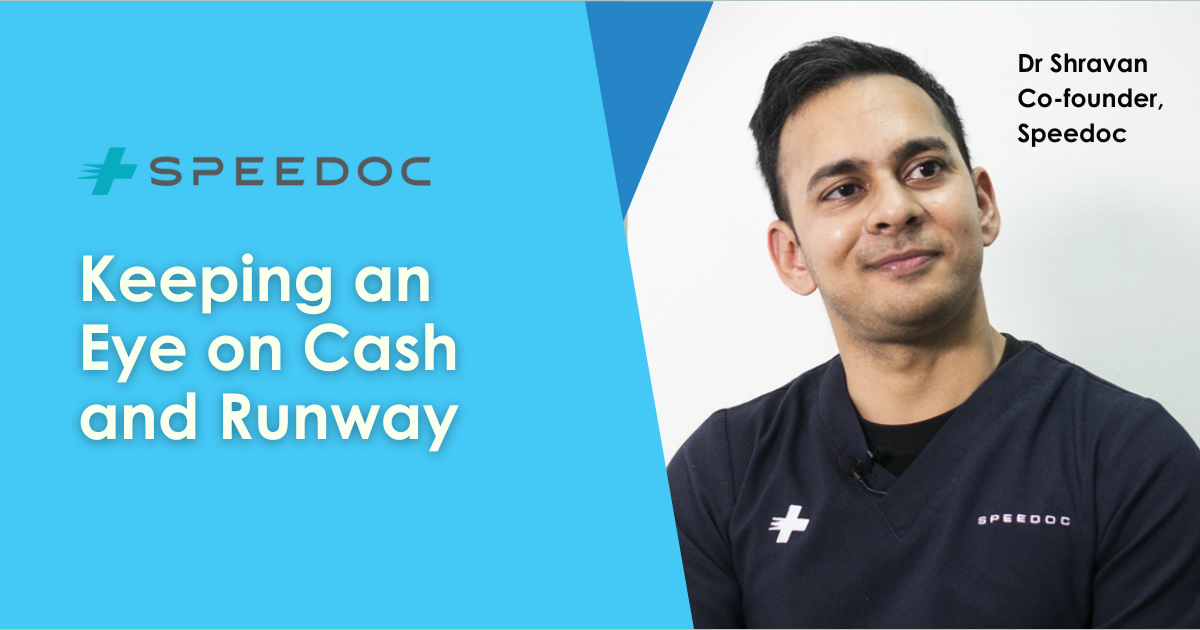
Keeping an Eye on Cash and Runway
While a founder's job typically entails keeping an eye on the big picture and speaking to the vision of the company, Shravan, co-founder of Speedoc*, showed that he was both capable of zooming in and out at the right time. He was clear that he needed a disciplined CFO to keep a close eye on the cash position for the company. To me, this is akin to having a “Minister of Home Affairs” to watch the home ground, while the country leaders go on their overseas expeditions, knowing that the home turf is in good hands.
Working closely with the CFO, Shravan was able to make sure the Speedoc team maintain strong gross margins, activate and keep the Accounts Receivables modest, and ensure that the expenses are in check. This enabled the co-founder to explore new business opportunities and also gave Shravan a lot of comfort when he was speaking with potential investors, as he had one less item (finances) to worry about.
As companies take time (easily 9 to 12 months in this economic climate) to raise funds, the CFO will have to ensure he has the ability to stretch whatever cash he has, to last at least 12 to 15 months, if not 18 months. We have seen founders being extremely stressed when they have less than 3 months of runway with no firm term sheet in sight, and this is not a good place to be in.
Anticipating Regulatory Changes
We always remind and encourage our founders to work closely with the regulators, keeping them informed of changes to their businesses, and even validating concepts and ideas with them on a regular basis. However, despite the best efforts, companies can be susceptible to regulatory changes that wipe out the business overnight.
Cellcast Interactive was one such case where it provided participants the ability to engage with TV / entertainment programs via “pay to participate”. The company was doing well and gaining good traction. However, one day, the regulators banned SMS for gaming without warning. Immediately, revenue tanked. While regulators subsequently lifted the ban, it had already taken too much of a toil on the company that we had to write off the investment.
Taking money off the table
Whenever there is an opportunity for liquidity, it should be seriously considered. Sometimes, it is better to take money off the table rather than hold out for a better outcome.
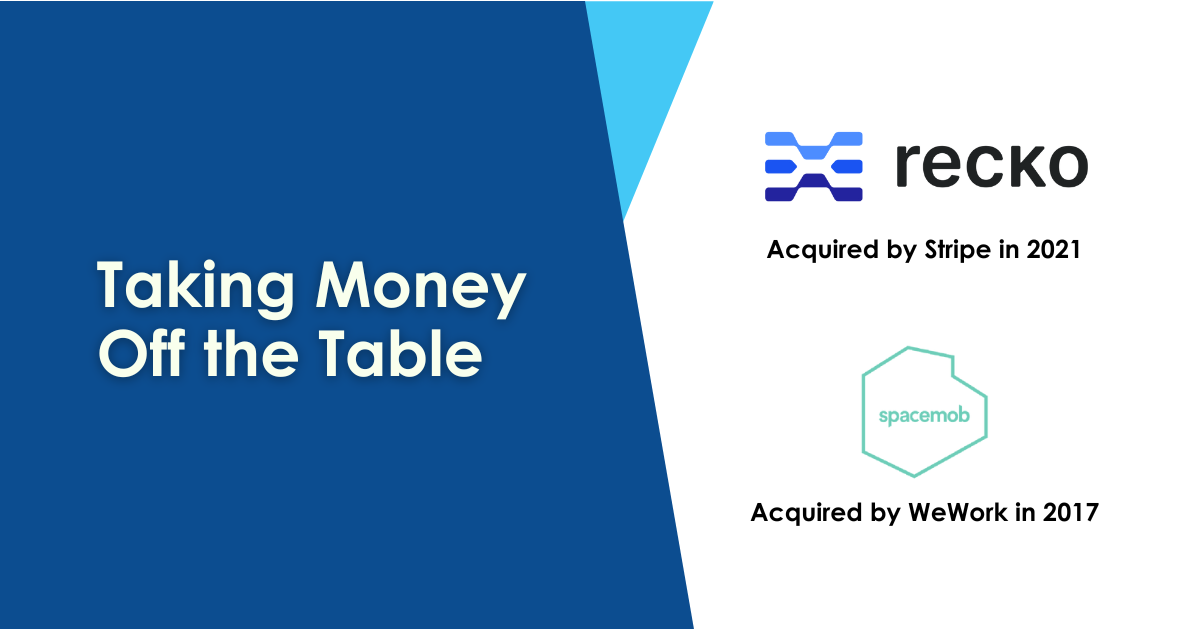
In late 2021, we received a generous offer from Stripe for a 100% buyout of Recko. Though we had only invested 18 months earlier, we decided to accept the offer, generating a significant return. Today, Stripe would be unlikely to make such an offer given its current cost-cutting.
We had a similar exit experience a few years ago too. An acquisition offer by WeWork happened within 20 months of our investment in Spacemob. As WeWork had raised a war chest of sizeable funds, it made logical sense to take money off the table, hence giving our fund a good exit within a short span of time.
In all, we are thankful to have had opportunities to realize good returns from a number of companies. Some of them happened when new investors came on board and bought shares back from early investors so they could average down their investment cost. This has also enabled us to return capital to our investors. We remain committed to seeking exits and not merely chasing the highest potential returns.
These are some of our learnings as an early stage investor, and I know there are many more. If you have a different experience as a founder or investor, I’d love to hear of it too!
*As an investor, we champion diversity. We featured one of the cofounders for these companies in our article above and would like to highlight that they have a female cofounder too! Turnkey Lender - Elena Ionenko, Patsnap - Guan Dian, Speedoc - Serene Cai,
**For the latest news on Vertex Ventures SE Asia and India and our portfolio companies, follow us on Linkedin or** subscribe to our monthly newsletter.
