
Investing in Drylab: Empowering Scientists to Build and Grow Intelligence Within Their Own Labs.

Walk into research labs and you would find the same scene - terabytes of sequencing data sitting on a server, with a queue of scientists waiting for someone who can actually code to analyse it. The bottleneck in life sciences has shifted. In 2001, sequencing a single human genome cost about US$100 million and today, it costs less than US$200. Generating data may no longer be the hardest part but making sense of it, and making decisions around it, is.
A typical biology project involves three tribes. The Principal Investigator owns the research question. Wet lab scientists who design and run the experiments to generate the data. Bioinformaticians, who are trained in computer science or statistics with biology as a minor, write the code that turns raw data into results for interpretation. On paper, it’s a neat division of labour driven by expertise and efficiency.
In practice, it presents a game of broken telephone. The data gets handed over, but the context typically gets blurred and lost in translation - the caveats, nuances, sensitivity notes that the biologist carries in their head. Every follow up question could mean another ticket in the queue, with much of that time spent waiting.
However, this is only the first part of the story. Cheap sequencing didn’t just create more data but, it also created an explosion of tools to analyse it. For single-cell RNA sequencing alone, public databases now track close to 2,500 tools and pipeline packages across the different stages of the workflow. Many of which are open-sourced tooling protocols accompanied with a steep learning curve. This scales exponentially when multiplied across other adjacencies such as genomics, proteomics, protein folding and molecular docking. Soon, you have a landscape where no single scientist, or even a seasoned bioinformatician, can realistically master.
Three fundamental changes. Data is abundant. Tooling is fragmented. And for the first time, AI agents can plan, reason, research and execute long, multi-step tasks reliably. That’s why we invested in Drylab.
Drylab, an AI company for life sciences, is introducing a different approach to scientific AI, which it calls “Self-Improving Intelligence. The idea behind Self-Improving Intelligence is simple: workflows improve, scientific knowledge accumulates, and lessons from past experiments inform future decisions. Over time, AI can become increasingly specialised to an organisation’s science, with that accumulated intelligence remaining under its control.
Today, Drylab turns analysis that once took weeks of specialized coding into results delivered in hours, through plain natural language. A researcher uploads their data, describes what they want to know, and Drylab works on the rest: literature research, data processing, running the right bioinformatics pipelines for the dataset, generating hypotheses, and writing up a publication-ready report.
In science, “almost right” is still wrong.
Unlike coding where AI can execute to make sure the generated code is correct, eval in Life Science is a tough problem. A plausible scientific answer can be worse than no answer at all. In a multi-step pipeline, one quiet mistake early on would be compounded to the final analysis. For Drylab, who is built around a proprietary eval system, reliability is the whole product, and not a feature.
Drylab is trained on biological datasets, experimental data and scientific workflows, allowing it to better understand biological concepts and perform multi-modal data analysis more effectively. Every analysis runs in an isolated sandbox and is captured as a full record of the data, code, tools, parameters and reasoning. That record can be exported as a notebook or report that a colleague or reviewer can rerun and check, thus ensuring reproducibility. Lastly, scientists shouldn’t have to trade intelligence for security. Drylab provides Desktop App for the highest level of security where private sensitive data never leaves the machine.
The team behind Drylab
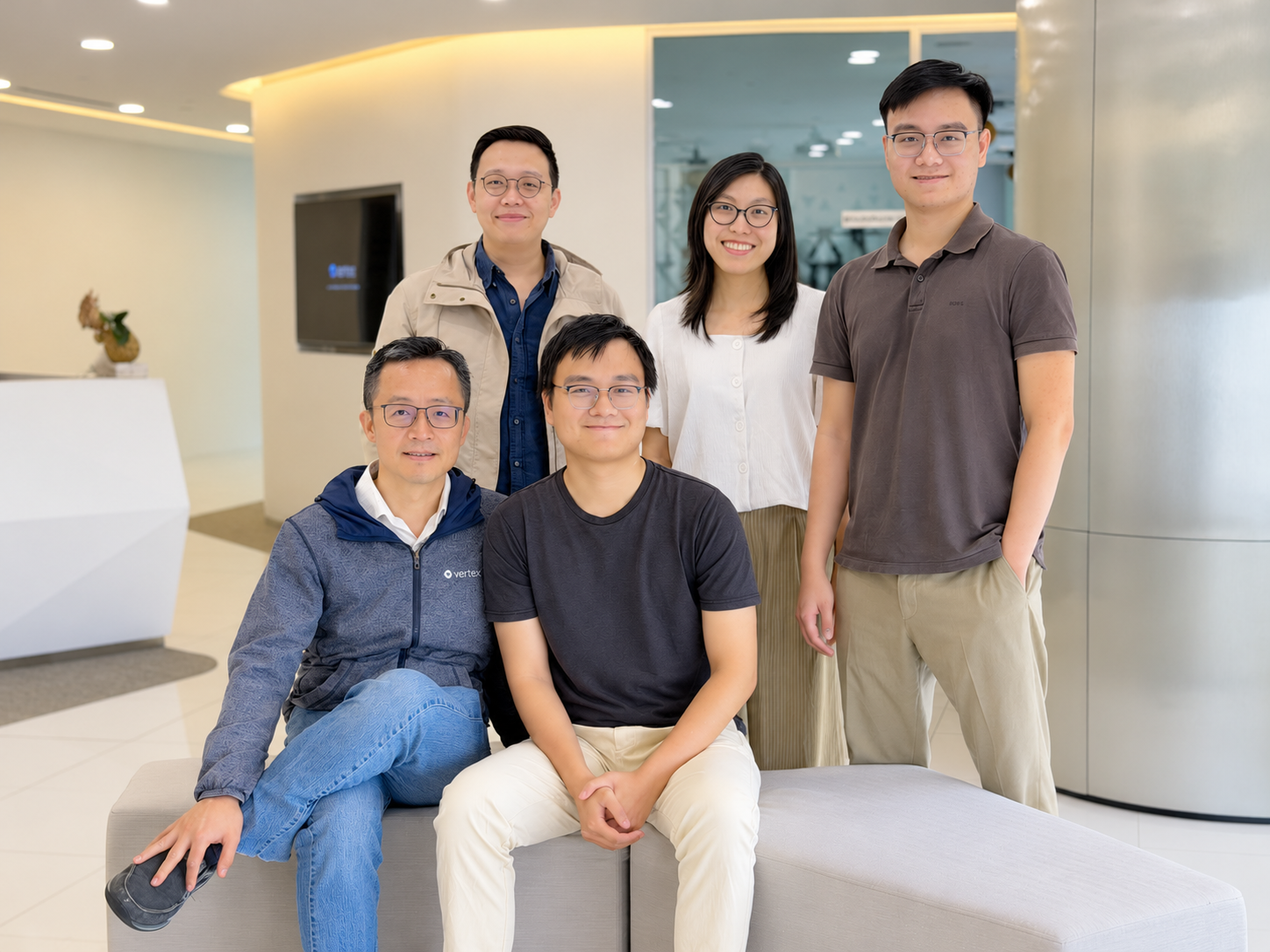 Behind Drylab is a rare mix of frontier AI talent and hands-on biology, CEO John Phan who worked at Bytedance and CTO Henry Phan who worked at LandingAi bring deep expertise in AI research while CSO Nhi Nguyen a biomedical researcher who lived with the problem before setting out to solve it.
Our long-term vision is not just to ask scientists to learn how to use AI. It is to help them grow frontier intelligence inside their own lab, intelligence shaped by their science, secured by their organisation, and capable of helping them push their scientific boundary further. We are excited for the potential of Drylab.
Scientists grow their intelligence. Intelligence helps them push the frontier.
By Benedict Tan & Alex Nguyen
For the latest news on Vertex Ventures SE Asia and India and our portfolio companies, follow us on Linkedin or subscribe to our monthly newsletter.
