
Investing in RapidCanvas: Productizing Enterprise AI

For decades, the largest pool of enterprise technology spend has not been packaged software. It has been custom: consultants and system integrators who design, customize, implement and run systems that businesses depend on. The numbers are large - IT and business services are estimated to be US $1.5T+ globally. AI fundamentally changes how services are delivered and therefore, impacts who captures it. Software can now do the work, not just assist the worker, and the software and services budgets are converging into a single AI Services as Software pool that we size at US$ 2.2T+.
The most valuable enterprise work sits in complex workflows: messy data from multiple systems, and decisions that still need human judgment. IT services never really reached these workflows, which didn't fit a project plan or a template. Internal teams tried, stitching together brittle integrations and dashboards that show what happened but don't act on it. The market has noticed, and keeps repricing the services model. Accenture fell nearly 18% on June 18 after cutting its outlook, then rose 15.8% on October 1 after a strong quarter, and India's Nifty IT index gained 14% in six sessions after TCS's results. But the rebound is in prices, not growth. TCS's USD revenue grew 2.4% year on year, while Palantir, the best-known platform-plus-forward-deployed-engineer model, grew 93% last quarter.
Palantir is no longer alone in this model. The AI labs and cloud providers are making the same bet. OpenAI launched its Deployment Company with more than US$4B, and Anthropic co-launched Ode, a reported US$ 1.5B services venture for midsize enterprises. AWS, Microsoft and Google Cloud have committed US$1B, US$2.5B and US$750M to the same forward-deployed model.
But not every company can buy this help, and the gap is widest in the mid-market. Enterprises with US$ 100M to US$ 10B in revenue, across manufacturing, financial services, retail and business services, have AI budgets and C-suite mandates but no proven path to outcomes. They face the same complex workflows as the Fortune 100, without the AI team or the US$10M transformation budget.
So why aren't these companies already served? Because nothing on the market fits. Services firms have flexibility but no leverage: they bill by the hour, start from zero on every engagement, and the knowledge leaves when the project ends. Vertical SaaS has leverage but no flexibility, so it breaks when a workflow doesn't match the template. Platforms offer both on paper, but only to companies with the AI talent to use them.
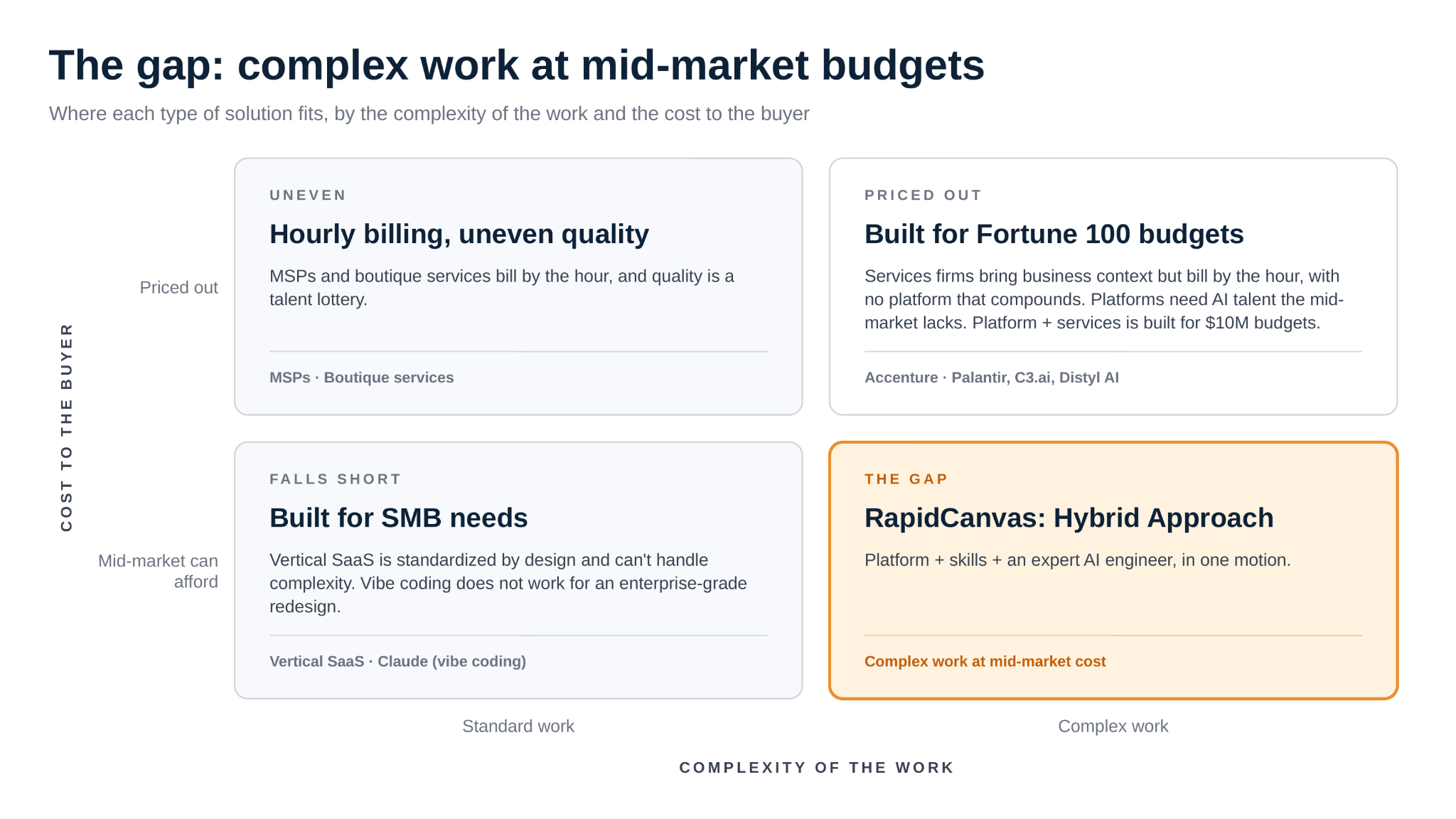
That is the gap RapidCanvas was built to close. It is led by co-founders Rahul Pangam and Uttam Phalnikar, who have worked together for more than 12 years and built Simility, an AI fraud-detection platform that PayPal acquired in 2018. Their Hybrid Approach pairs an agentic AI platform with field AI engineers who learn each customer's business, build the custom application, and stay accountable for the outcomes. Here is how the pieces fit together.
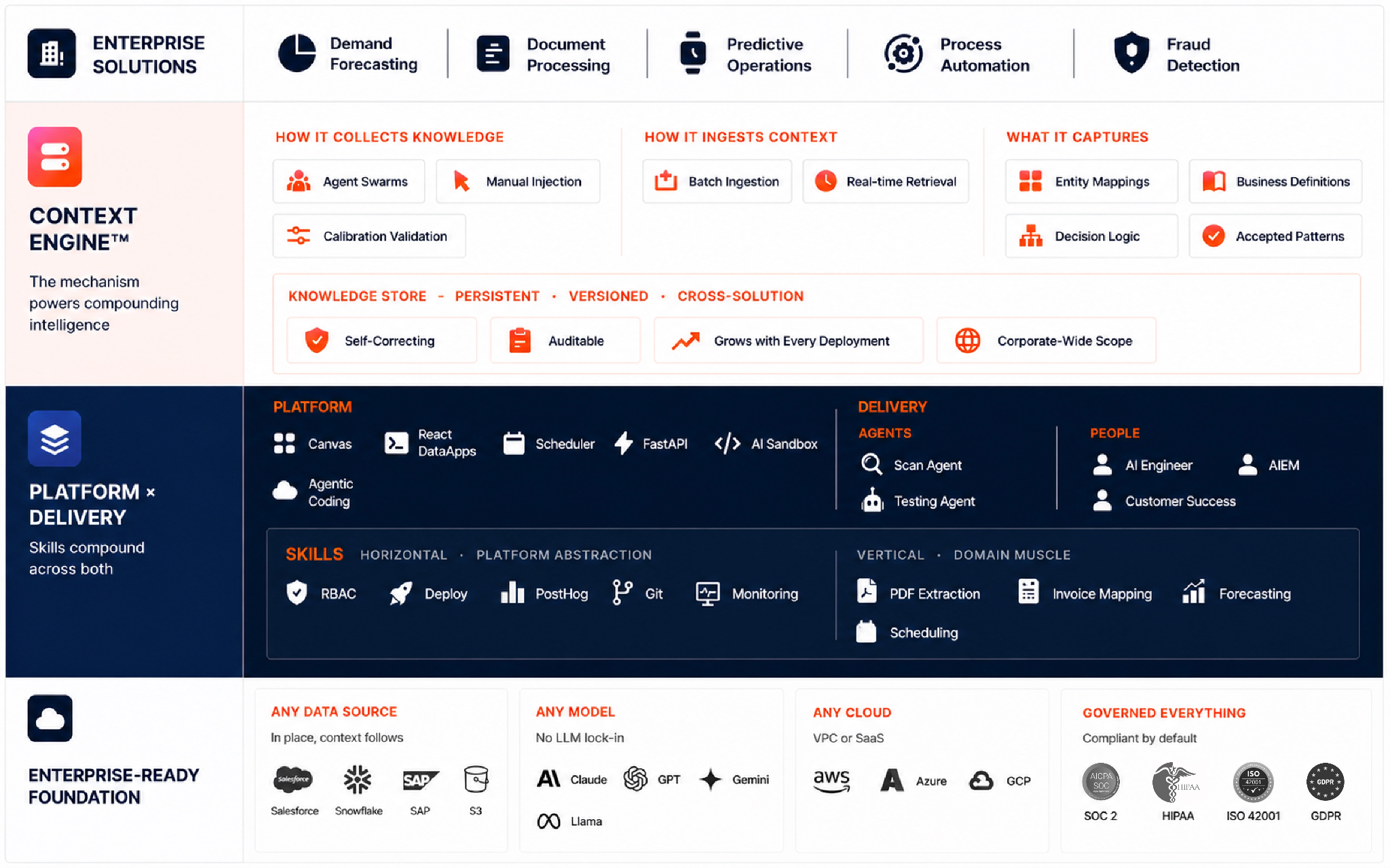 The full stack at a glance. Enterprise Solutions sit on top, the Context Engine in the middle, and Platform × Delivery underneath, with an enterprise-grade foundation supporting all of it. The Context Engine records how a business process really works: the requirements, the tribal knowledge, the data schemas and the history of past decisions. The enterprise owns that record, and it grows with every deployment. Platform × Delivery gives each new solution a 60% head start through a library of reusable skills, and adds the field AI engineers who build on it and stay accountable after go-live. The foundation works with any data source, any model and any cloud, and is governed by default.
The effect compounds. Every deployment feeds the next, so what starts as custom delivery becomes repeatable. Customers pay a subscription with no separate services line, and the model has software-like gross margins, far above what services businesses typically earn.
And the customer pull is the proof. Over 40% of customers now run multiple AI use cases in production, and this year more than 75 enterprises have used RapidCanvas applications to make 1.4 million AI-led decisions.
That is why we are excited to lead RapidCanvas's US$29M Series B, with Hitachi Ventures joining and its existing investors participating again.
Enterprise AI will be won on outcomes, not demos. We look forward to working with Rahul, Uttam and the RapidCanvas team as they bring production-grade AI to every enterprise.
For the latest news on Vertex Ventures SE Asia and India and our portfolio companies, follow us on Linkedin or subscribe to our monthly newsletter.
